
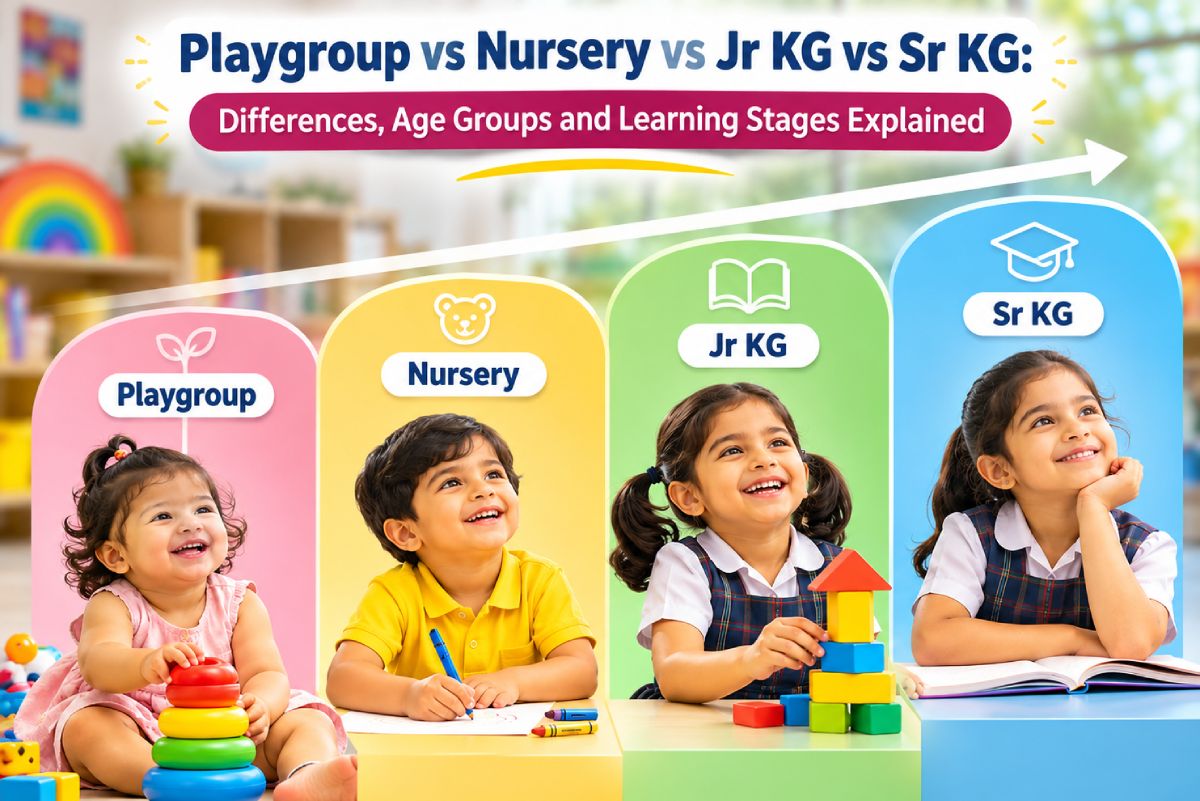
Playgroup, Nursery, Junior KG, and Senior KG are four stages of early childhood education, taken roughly between the ages of two and six. Playgroup (about 2–3 years) is an optional first step focused on play and settling away from home. Nursery (about 3–4), Junior KG (4–5) and Senior KG (5–6) are the three formal pre-primary years before Class 1. Under the National Education Policy 2020 and Maharashtra's new rules, these three years are now also called Balvatika-1, 2 and 3.
When exploring preschool admissions, parents in Kalyan often come across different stages such as Playgroup, Nursery, Junior KG and Senior KG, along with terms like LKG, UKG and pre-nursery. This guide sorts out what each stage means, what children learn, the ages that apply in Maharashtra, and how to decide where your child should start.
What are the stages of pre-primary education?
Pre-primary education covers the years before formal schooling starts in Class 1. In India, the usual sequence is:
| Stage | Other names | Typical age | Main focus |
| Playgroup | Pre-nursery, toddler group | 2 to 3 years | Settling away from home, play, first social contact |
| Nursery | Balvatika-1, Pre-KG | 3 to 4 years | Language, routines, sensory play, early motor skills |
| Junior KG | LKG, Balvatika-2 | 4 to 5 years | Letter sounds, counting, fine motor skills, group play |
| Senior KG | UKG, Balvatika-3 | 5 to 6 years | Early reading, writing and number work, readiness for Class 1 |
Understanding the age groups for Nursery, Jr KG and Sr KG helps parents choose the right pre-primary stage based on their child's age, development and readiness.
What is Playgroup, and does my child need it?
A playschool in Kalyan can offer young children a gentle introduction to group learning through activities such as storytelling, rhymes, creative play and social interaction. Children play, sing, listen to stories, and get used to spending time with other adults and children.
Playgroup is optional. It is not part of the three pre-primary years recognised under NEP 2020, and Maharashtra's new age rules start at Nursery. Many children go straight from home to Nursery and settle well.
Playgroup can help when:
- Your child has had little contact with other children, for example as an only child in a nuclear family.
- Both parents work, and you want a structured setting before full school hours.
- Your child is shy or anxious about separation and would benefit from a slower start.
It may not be needed when your child already spends regular time with other children and is comfortable with new adults.
What happens in Nursery?
Nursery is the first formal pre-primary year. From 2027–28, a child must be at least three years old by 30 June to join Nursery in Maharashtra.
The Nursery day builds habits and language more than academics. Choosing a nursery school in Kalyan West that prioritises play-based activities, communication and social interaction can help children develop confidence during their early learning years. Children learn to follow a routine, sit for a story, ask for help, use the toilet independently and play alongside others. Activities typically include:
- Rhymes, songs and picture books to grow vocabulary
- Sand, water, clay and colour play for sensory and motor development
- Sorting, matching and simple counting with objects
- Outdoor play for balance and coordination
- Circle time for listening and speaking
A child who leaves Nursery able to listen, share, speak in short sentences, and hold a crayon is on track. Reading and writing come later.
How is Junior KG different from Nursery?
Junior KG builds on Nursery with more structure. Children begin connecting sounds to letters, recognising numbers and using their hands for finer tasks.
Typical Junior KG learning includes letter sounds (phonics), tracing and patterns, counting objects to 20 or beyond, shapes and colours, simple puzzles, and group activities that need turn-taking. Play remains central; a good Junior KG classroom looks busy and hands-on, not like rows of children copying from a board.
From 2028–29, the minimum age for Junior KG in Maharashtra will be four years by 30 June.
How does Senior KG prepare a child for Class 1?
While Jr KG and Sr KG gradually build academic and social skills, Senior KG prepares children for the transition into Class 1.
- Blend sounds to read simple words and short sentences
- Write letters and simple words without tracing
- Count, compare, and do simple addition and subtraction with objects
- Follow two- or three-step instructions
- Work on a task independently for 15–20 minutes
- Express needs and feelings in words
Senior KG also introduces the classroom habits Class 1 needs, such as carrying their own bag, managing belongings, and moving between activities on time. From 2029–30, the minimum age for Senior KG in Maharashtra will be five years by 30 June.
What does Balvatika mean?
Understanding the Balvatika meaning helps parents recognise how India's NEP 2020 framework organises the three pre-primary years into structured, play-based learning stages:
- Balvatika-1 = Nursery
- Balvatika-2 = Junior KG (LKG)
- Balvatika-3 = Senior KG (UKG)
Together with Classes 1 and 2, the Balvatika years form the foundational stage of NEP's 5+3+3+4 structure, covering ages three to eight. The policy's idea is that these five years should be one continuous, play-based stage, rather than three years of preschool followed by a sudden jump into formal schooling.
Maharashtra's Government Resolution of 15 October 2026 uses these names alongside the familiar ones. Your child's classroom does not change because of the label.
What are the age rules for each stage in Maharashtra?
For preschool admissions in Maharashtra, parents should understand the revised 30 June age cut-off and the minimum age requirements being introduced for each pre-primary stage.
| Stage | Minimum age by 30 June | Applies from |
| Nursery (Balvatika-1) | 3 years | 2027–28 |
| Junior KG (Balvatika-2) | 4 years | 2028–29 |
| Senior KG (Balvatika-3) | 5 years | 2029–30 |
| Class 1 | 6 years | 2030–31 |
Playgroup is not covered by these rules, so each playschool sets its own age range. For examples by date of birth, see our guide to the new school admission age rules in Maharashtra.
Standalone playschool or a school's pre-primary section?
When choosing a playschool in Kalyan, parents can compare standalone early learning centres with schools that offer their own pre-primary sections from Nursery to Senior KG.
| Question | Standalone playschool | School with a pre-primary section |
| Will my child need a new admission for Class 1? | Yes | Usually no; children move up within the school |
| Does the curriculum lead into a board? | Depends on the playschool | Built to lead into the school's own board curriculum |
| How far from home? | Often very close | May be further; transport matters |
| Day length | Often shorter | Fixed timings |
| Facilities | Usually smaller | Access to larger spaces, library, play areas |
Choosing the right playschool in Kalyan depends on your child's readiness, preferred learning environment, location, and plans for primary education. Enrolling in a nursery school in Kalyan West that also offers primary education can provide children with continuity in their learning journey and reduce the need for another school admission later.If proximity and a small setting matter more right now, a good playschool near home is a sensible choice. Our guide on how to choose the best preschool in Kalyan lists 10 things to check either way.
How do you decide which stage your child should start in?
When comparing options, parents looking for a nursery school in Kalyan West should also consider the school's learning environment, teaching approach, and opportunities for a smooth transition into higher grades.
Start with age, then look at readiness:
- Check the date of birth against the minimum age for the year you are applying.
- Consider readiness, not only age. Can your child communicate basic needs, manage short separations, and follow simple instructions? Our Nursery readiness checklist helps here. [Link live once published.]
- Avoid skipping stages to get ahead. A child placed with older classmates can struggle socially even if they cope academically.
- Think about continuity. Each move between schools takes a few weeks of settling. Fewer moves help most young children.
Pre-primary education at Gautam Singhania Global School, Kalyan
Gautam Singhania Global School is an ICSE school in Umbarde, Kalyan West, with classes from Nursery to Grade 7. Children who join in Nursery, Junior KG or Senior KG can continue into primary and middle school on the same campus, without a fresh admission at Class 1.
The school's pre-primary stage page explains how the early years are organised. For preschool admissions, parents can check the school's admissions page or contact the admissions team to understand current age criteria, available seats, and the application process.
Frequently asked questions
What is the difference between Nursery and Jr KG?
Nursery (about 3–4 years) focuses on routines, language, and play. Junior KG (about 4–5 years) adds letter sounds, number recognition, and finer hand skills.
Is LKG the same as Junior KG?
Yes. LKG, Junior KG and Balvatika-2 are different names for the same year.
Is UKG the same as Senior KG?
Yes. UKG, Senior KG and Balvatika-3 all refer to the final pre-primary year before Class 1.
At what age should a child start Nursery in Maharashtra?
From 2027–28, a child must be at least three years old by 30 June of the admission year.
Is playgroup compulsory before Nursery?
No. Playgroup is optional. Many children go directly from home to Nursery.
What is Balvatika?
Balvatika is the NEP 2020 name for the three pre-primary years: Balvatika-1 (Nursery), Balvatika-2 (Junior KG) and Balvatika-3 (Senior KG).
What should a child know before Class 1?
Most children finishing Senior KG can read simple words, write letters, count and do simple sums with objects, follow multi-step instructions and work independently for short periods.
Can a child skip Junior KG?
Schools may admit a child of the right age directly into Senior KG. Skipping a year to move ahead early is not usually recommended, because social and emotional readiness matter as much as academics.
Summary
Playgroup is an optional first step; Nursery, Junior KG and Senior KG are the three formal pre-primary years, now also called Balvatika 1 to 3. Each stage moves gradually from play and routines towards early reading, writing, and numbers. In Maharashtra, check the 30 June minimum age for your admission year, and choose a setting that suits your child's readiness and your plans for primary school.
Next step: explore the pre-primary stage at Gautam Singhania Global School or contact the admissions team.